Sidewalk Concrete Contractors: Quality, Code and Hiring

Updated: 5 days ago
A sidewalk can look simple, but its performance depends on what happens below the finished surface. Poor grading, weak subgrade preparation, incorrect slope, or missing control joints can lead to uneven panels, standing water, and premature cracking. In Los Angeles and Orange County, the work may also involve local permit requirements and questions about who is responsible for the walk.
The right sidewalk concrete contractors plan for drainage, prepare a stable base. Place concrete at an appropriate depth, install control and expansion joints, and finish and cure the surface carefully. They should also be licensed, insured, and prepared to explain how the proposed work addresses applicable local requirements.
For a larger repair or replacement, professional oversight helps connect the visible finish with the details that protect it over time. LevelWorks handles paver and concrete projects across Southern California, from grading through sealing. The next step is knowing which questions reveal whether a contractor can deliver that level of work.
Request a sidewalk estimate from LevelWorks or call (855) 202-2015 to talk through your project with a licensed, insured concrete contractor serving Los Angeles and Orange County.
What Should You Look For in Sidewalk Concrete Contractors?
When comparing sidewalk concrete contractors, look beyond a polished website and a low bid. The right professional should make the project easy to understand, document the scope clearly, and demonstrate the technical experience needed for a durable, safe walkway. In Los Angeles and Orange County. Local knowledge also matters because sidewalk requirements and responsibility can vary by municipality and by whether the walk is on private property or in the public right of way.
Confirm licensing, insurance, and worker's compensation
Ask whether the contractor is licensed, bonded, and insured in California, then verify the information before work begins. Request current proof of general liability coverage and active worker's compensation insurance if employees or subcontractors will be on the site. These checks help protect your property and reduce uncertainty if an injury or construction issue occurs.
A qualified contractor should also be comfortable discussing permits, local requirements, drainage, and site preparation. Sidewalk work is not only about placing concrete. The team may need to evaluate grading, existing roots, transitions, expansion joints, and the relationship between the walkway and nearby driveways or patios.
Expect a detailed written bid
A written bid should describe demolition, excavation, subgrade preparation, concrete depth, reinforcement if needed, forms, control joints, finish, cleanup, and any permit or disposal costs. It should identify the materials and the expected schedule rather than relying on a single general number. Compare several qualified bids by scope, communication, references, warranty terms, and completion date, not by price alone.
Be cautious if someone pressures you to decide immediately, requests full payment before work starts, or will not explain what the proposal includes. Clear communication at the beginning usually leads to better decisions throughout the project.
Review relevant work and references
Ask for references and examples of completed walkways, not only large patios or driveways. Look for consistent edges, even transitions, clean control joints, and a finish that complements the home. A contractor who handles grading, drainage, concrete, and pavers can help coordinate the entire outdoor approach. Review LevelWorks' pavers and concrete work in Los Angeles to see how those services fit together, or explore the broader concrete construction services available for a full property project.
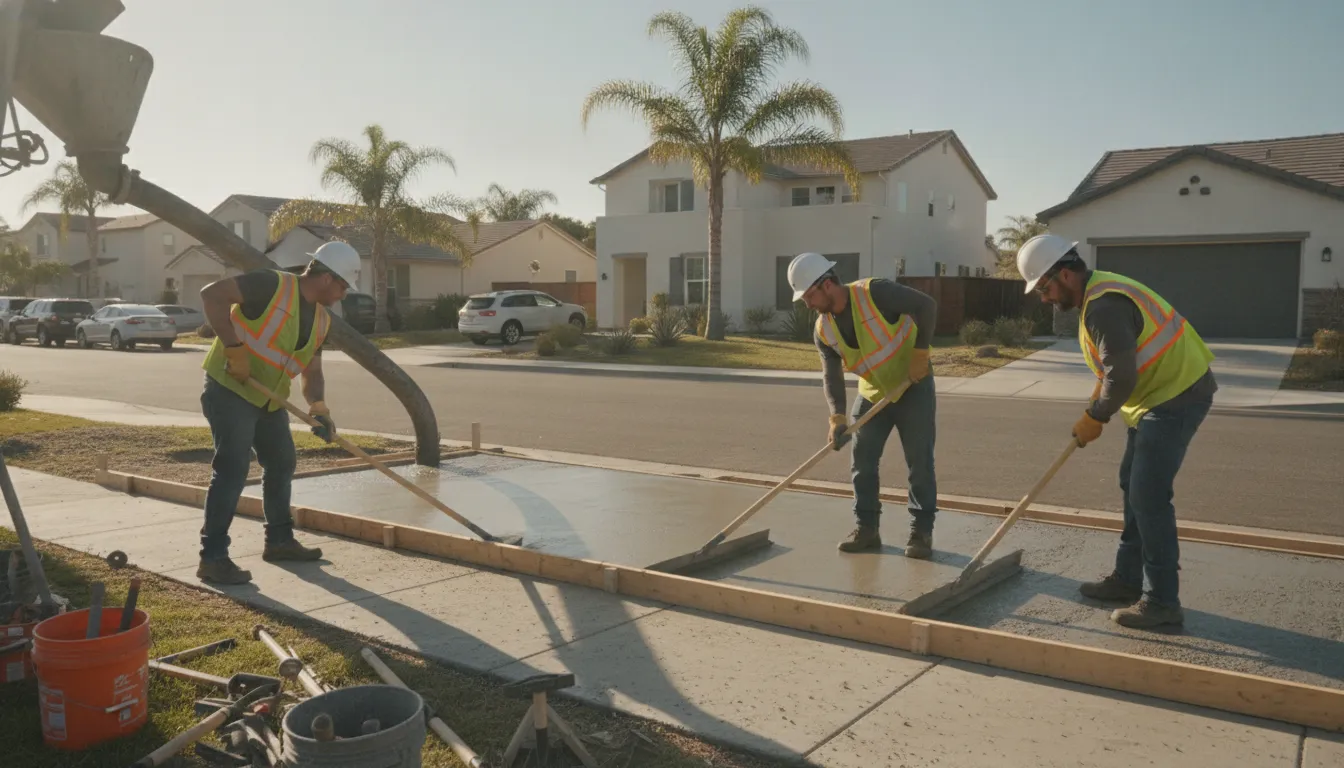
Finally, choose a team that answers questions directly and keeps the project organized from planning through completion. LevelWorks serves more than 90 Southern California cities and brings design, permitting, construction, and project management into one process. That coordination can help your new sidewalk look intentional, perform well, and remain part of the property's overall design.
What Does a Code-Compliant Sidewalk Installation Look Like?
A quality sidewalk starts below the visible surface. Before concrete is placed, the installation area should be excavated to a consistent depth, cleared of loose material, and compacted over a stable subgrade. If the soil is soft or uneven, the contractor may need to improve the base so the walk can support regular foot traffic without settling or cracking prematurely.
For a typical pedestrian sidewalk, concrete is commonly placed at approximately 4 inches thick. The exact requirement can vary with the site, local municipal standards, soil conditions, and whether the walk will carry anything more substantial than pedestrians. A professional evaluation should confirm the required depth rather than treating 4 inches as a universal rule.
How slope and drainage protect the finished walk
A sidewalk should guide water away from the home and toward an approved drainage path. That requires careful attention to grade, transitions, adjoining driveways, curbs, and entry points. The finished surface needs enough slope to shed water without creating an uncomfortable or unsafe walking path. Where a sidewalk meets a driveway or street, the transition should be planned so it does not create an abrupt lip or collect runoff.
Drainage is especially important in hardscape projects because standing water can weaken the base, stain the concrete, and contribute to movement around adjacent paving. Experienced hardscaping contractors in Los Angeles review the entire outdoor area instead of treating the sidewalk as an isolated strip of concrete.
Joints, finishing, and curing matter
Control joints create planned lines where normal shrinkage can occur, helping reduce random cracking. Expansion joints may be needed where the sidewalk meets a building, curb, driveway, or another rigid structure. The layout and spacing should suit the dimensions of the walk and the surrounding construction.
After placement, the concrete should be finished for traction and a clean, consistent appearance. Overworking the surface or adding excess water can weaken the finish. Proper curing then gives the concrete time to gain strength. The contractor should explain when the walk can be used and protect it from premature foot traffic during the initial curing period.
Permits and local sidewalk responsibility
Sidewalk work near a public street can involve more than a homeowner's private improvement. Los Angeles and Orange County cities may have different requirements for permits, right-of-way work, slope, thickness, expansion joints, accessible transitions, and corner-cut details. In many cities, the municipality owns or controls the sidewalk area next to the street. While the homeowner may be responsible for a private walk path on the property. Responsibility for repairs can also depend on the location and the local code.
Before demolition or concrete placement, confirm which agency has jurisdiction and whether a permit or inspection is required. A licensed, bonded, and insured California contractor can help identify the applicable municipal requirements, coordinate permits when needed, and document the installation plan. That preparation supports a safer, longer-lasting result across Greater Los Angeles and Orange County.
How Much Do Sidewalk Concrete Contractors Charge?
The cost of sidewalk work depends on the scope of the installation, not just the concrete itself. A short private walkway with easy access has different requirements than a long path that needs demolition, grading, drainage, or careful work around existing landscaping. Sidewalk concrete contractors should review the site in person and explain those variables before preparing a bid.
What affects the scope of sidewalk work?
- Length and width:
Contractors measure the total square footage and, when appropriate, the linear feet of the walkway. More area requires more materials, labor, forming, finishing, and curing time.
- Depth and subgrade:
The required concrete depth, base preparation, soil conditions, and drainage plan all affect the work. If the existing ground is soft, uneven, or poorly compacted, the crew may need to remove and rebuild the subgrade before placing concrete.
- Removal and replacement:
Replacing a cracked or settled walk includes demolition, hauling, disposal, and preparation before new concrete is installed. New construction may require layout, excavation, forms, and transitions to connect with existing surfaces.
- Site access:
Narrow gates, steps, slopes, mature plants, walls, and limited staging space can change how materials and equipment reach the work area. A thorough site review helps identify these conditions early.
- Permits and compliance:
Public-facing sidewalks can involve local permits, inspections, slope requirements, expansion joints, and accessibility considerations. A professional contractor can clarify which approvals apply to the property and coordinate the work accordingly.
Questions about a 200-foot concrete driveway often focus on total area and site conditions. The same cost shape applies to a sidewalk, but sidewalk work also requires close attention to pedestrian access, property lines, transitions, and local requirements. The measurement should be based on the actual walkway design rather than a generic per-foot assumption.
What should an itemized bid include?
Ask for a written, itemized bid from a licensed and insured contractor. It should identify demolition, excavation, subgrade preparation, concrete depth, reinforcement if needed, forming, finishing, control joints, curing, permits, cleanup, and any restoration around the walkway. The bid should also state what is included, what conditions could change the scope, and how the project will be scheduled.
LevelWorks provides concrete and hardscape services across Greater Los Angeles and Orange County. To discuss your property and request an itemized sidewalk estimate, request an estimate from LevelWorks or call (855) 202-2015.
When Should You Hire Sidewalk Concrete Contractors Instead of DIY?
A small concrete step or garden path can be a reasonable DIY project when the area is private, lightly used, and easy to prepare. A public-facing sidewalk is a different responsibility. In Los Angeles and Orange County, the work may need to meet local requirements for slope, thickness, expansion joints, accessibility, and permits. It also has to connect safely with existing pavement, driveways, walkways, and drainage.
That is why many homeowners choose professional sidewalk installation when the project affects an entrance, the street frontage, or a larger section of concrete.
Can a handyman do concrete work?
A handyman may be capable of patching a small crack. Setting a form for a minor private project, or completing a simple repair that does not involve municipal requirements. However, a handyman is not automatically qualified to manage a sidewalk replacement. Ask who will confirm the required permits, check the finished grade, prepare the subgrade, and take responsibility for compliance if the sidewalk borders a public right of way.
For a larger installation, use a licensed and insured concrete professional who can explain the scope clearly and provide written documentation. LevelWorks is licensed, bonded, and insured in California, and its team manages hardscape work from grading through finishing.
Consideration | DIY sidewalk work | Hiring a concrete contractor |
Permits and code | Homeowner must identify and manage all local requirements | Contractor confirms jurisdiction and coordinates permits |
Subgrade and grading | Risky without experience; weak base causes settling | Crew prepares and compacts a stable subgrade |
Compliance and liability | Homeowner carries responsibility for the result | Licensed, bonded, insured contractor responsible |
Best for | Small, private, lightly used paths | Public-facing, high-traffic, or larger sidewalk work |
Why sidewalk preparation matters
Concrete does not compensate for a weak base. Before the pour, the installer may need to remove unsuitable material, compact the subgrade, establish drainage, and set forms at the correct elevations. A pedestrian sidewalk commonly requires a properly prepared section of concrete around four inches deep, but the exact requirements depend on the project and local jurisdiction. Control joints, finishing, and curing also affect how the surface performs over time.
Municipal responsibility can make the project more involved. Cities often own the sidewalk strip adjacent to the street, while homeowners may be responsible for private walk paths on their property. A licensed contractor can help clarify the work area and identify whether a city inspection, permit, or specific repair detail is required before demolition begins.
DIY makes sense only when the work is genuinely small, private, and within your experience. Hire a professional when the sidewalk is cracked across a broad area, carries regular foot traffic. Meets a driveway or curb, sits on a slope, affects accessibility, or requires permits. Proper preparation and compliance are what separate a clean-looking pour from a sidewalk that remains safe and serviceable.
How Do You Vet a Sidewalk Contractor Before You Hire?
A polished proposal is useful, but it is only the beginning. Before choosing among sidewalk concrete contractors, confirm that the company can legally and safely perform the work, understands local requirements, and communicates exactly what the project includes.
Verify licensing, insurance, and workers' compensation
Ask for the contractor's California license information and verify it with the Contractors State License Board, commonly called the CSLB. Confirm that the business name and license status match the company you are considering. You should also request proof of general liability insurance and confirm that workers' compensation coverage is active if employees or other workers will be on the property.
These checks are especially important for sidewalk work near driveways, public right-of-way areas, landscaping, and active walkways. A qualified contractor should be comfortable answering direct questions about licensing and coverage. Avoid anyone who treats those questions as an inconvenience or offers only vague assurances.
Compare written, itemized bids
Request written proposals from several qualified contractors. Each bid should identify demolition or removal, grading and base preparation, concrete thickness, reinforcement if applicable, control joints, finishing, cleanup, permits, and any restoration around the walkway. Ask how changes will be handled if the existing soil, drainage, or adjacent concrete requires additional work.
Do not compare bids by total price alone. Review the scope, materials, schedule, warranty terms, payment milestones, and exclusions side by side. An unusually low bid may leave out preparation or cleanup that another contractor included. A clear, itemized proposal makes it easier to compare the actual work and reduces misunderstandings later.
Check references and observe current work
Ask for references from recent projects that resemble your sidewalk. Speak with the homeowners about communication, site care, schedule reliability, and how the finished concrete has held up. If possible, visit an active project or completed installation with permission. Look for clean edges, consistent finishing, well-placed joints, and an orderly job site.
For additional contractor-selection context, review this guide on reliable sidewalk concrete contractors. The same habits apply to both driveway and walkway projects.
Watch for pressure tactics
Be cautious when someone demands an immediate decision, requests full payment before work begins. Insists on cash only, or arrives uninvited claiming to have leftover materials from another job. A dependable professional gives you time to review the proposal and answers questions without pressure. Clear communication before construction is one of the strongest signs that the project will be managed responsibly.
Request a detailed sidewalk estimate and confirm the scope, permits, and schedule before you commit. Call LevelWorks at (855) 202-2015 to discuss your project.
Frequently Asked Questions
How deep should concrete be for a sidewalk?
A typical pedestrian sidewalk is often designed around 4 inches of concrete, but the right depth depends on site conditions, intended use, soil, drainage, and local requirements. A contractor should confirm the design before excavation, prepare a stable subgrade, and plan control or expansion joints to help manage movement and cracking.
Do I need a permit to replace a sidewalk in Los Angeles or Orange County?
Possibly. Permit and inspection requirements vary by city, especially when the work is near a public right-of-way, driveway apron, corner, curb, or accessible route. Before demolition, confirm the requirements with the city or agency responsible for the frontage. A professional contractor can help identify the applicable permit, slope, joint, and accessibility requirements.
Can a handyman do concrete sidewalk work?
A handyman may be suitable for limited repairs, but a full sidewalk replacement requires careful grading, forming, reinforcement decisions, concrete placement, finishing, curing, and compliance review. For work involving a public walkway or drainage concerns, choose a licensed, bonded, and insured concrete contractor with relevant references and project-management experience.
What should be included in a sidewalk concrete bid?
Request a written scope that identifies demolition, excavation, subgrade preparation, concrete depth, reinforcement, joints, finish, drainage, permits, cleanup, schedule, and warranty terms. Compare qualified bids on the complete scope rather than price alone. Also verify licensing, insurance, active workers compensation coverage when employees are on site, and recent references before signing.
Ready to Plan Your Sidewalk Concrete Work?
Request your sidewalk estimate from LevelWorks and get clear guidance on installation details, local requirements, and the practical demands of your property. LevelWorks handles concrete and paver projects across Los Angeles and Orange County, from grading through finishing. Call (855) 202-2015 to discuss your sidewalk project with the team.